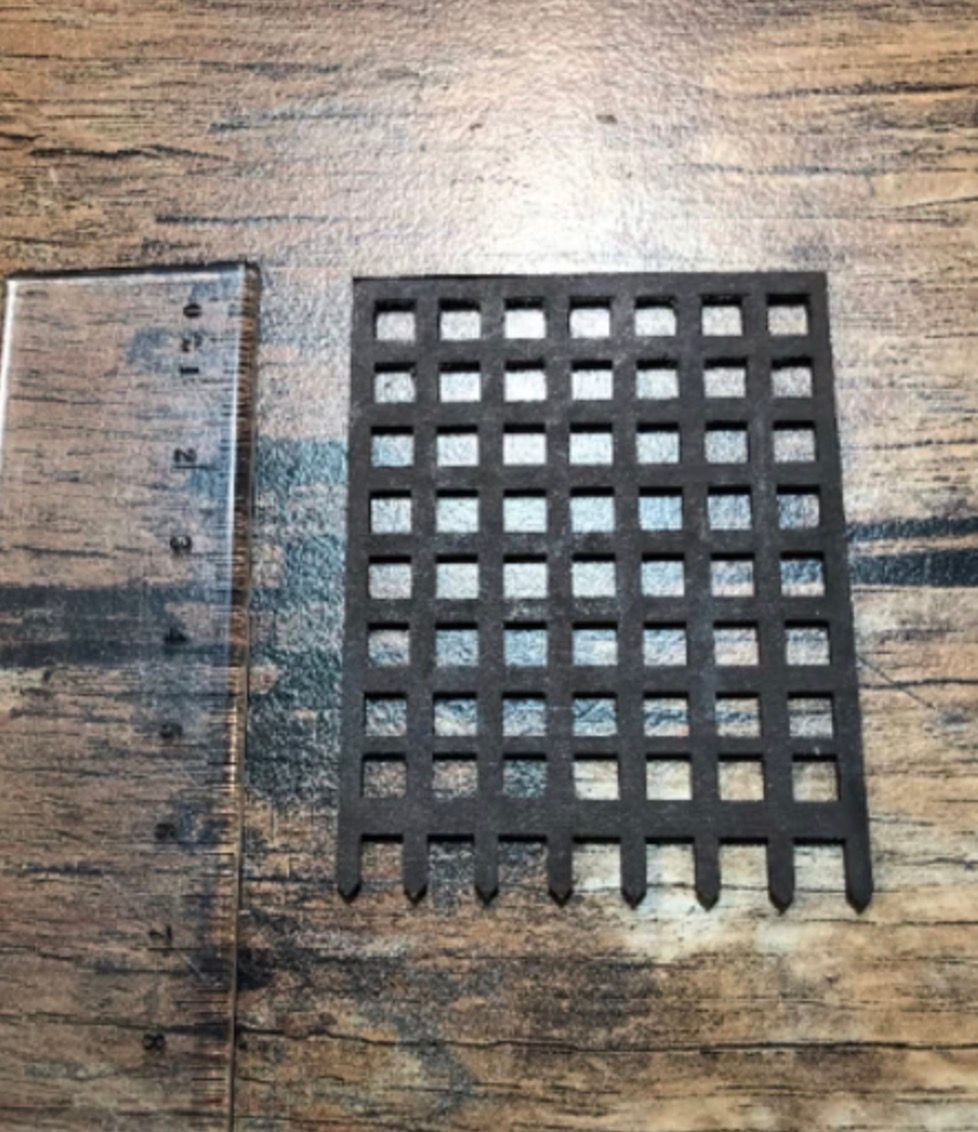
Flat-packed and ready for construction in the colours of your choice. I used copic and promarker staining pens rather than paint.
Size: 6.5 cms height x 5 cms wide.
A portcullis (from the French porte coulissante, “sliding door”) is a heavy vertically-closing gate typically found in Medieval fortifications, consisting of a latticed grille made of wood, metal, or a combination of the two, which slides down grooves inset within each jamb of the gateway.
They fortified the entrances to many medieval castles, securely closing them during times of attack or siege. Every portcullis was mounted in vertical grooves in the walls of the castle and could be raised or lowered quickly by means of chains or ropes attached to an internal winch.
Often, two portcullises at the main entrance were used. The one closer to the inside would be closed first, and then the one farther away. This was used to trap the enemy, and often, burning wood or fire-heated sand would be dropped onto them from the roof or murder holes. Hot oil, however, was not commonly used in this manner, contrary to popular belief, since oil was extremely expensive. Arrowslits in the sides of the walls enabled archers and crossbowmen to eliminate the trapped group of attackers.
In England, working portcullises survive at the Tower of London, Monk Bar, York and Hever Castle, Kent and at the hotel conversion, Amberley Castle. In Scotland, there is a working portcullis at Edinburgh Castle.
Photos featured are the property of Raptoor Crafting, used with permission.
PORTCULLIS 1/48 scale KIT
£5.00
SPECIFICATIONS
Size: 6.5 cms height x 5 cms wide.
HOW TO USE
DETAILS